Scaler 2 Plugin Review: A Music Producer’s 6-Month Studio Test
The Scaler 2 plugin has reshaped my music production workflow in the last six months. This powerful chord progression tool gives me access to over 200 new chord sets, hundreds of scales, and 30 more instruments – way more than my original expectations from a music theory workstation.
Music producers always need fresh inspiration, and this chord progression plugin delivers with its impressive MIDI and audio detection capabilities. I started my Scaler 2 review with doubts. Would it detect keys and scales from existing music accurately? The results blew me away. The Scaler 2 VST does more than suggest matching chords. It offers humanized expressions from professional musicians that add natural-sounding melodies to productions. The price tag makes sense at $59.99 (with an introductory price of $49) compared to other tools available today.
Six months of intense testing with Scaler 2 across projects and DAWs gave me deep insights. This hands-on review will show how this music theory assistant tackles ground production challenges. You’ll learn if its extensive features justify the cost and whether it deserves a permanent place in your production toolkit.
What Is Scaler 2 Plugin and Who Is It For?
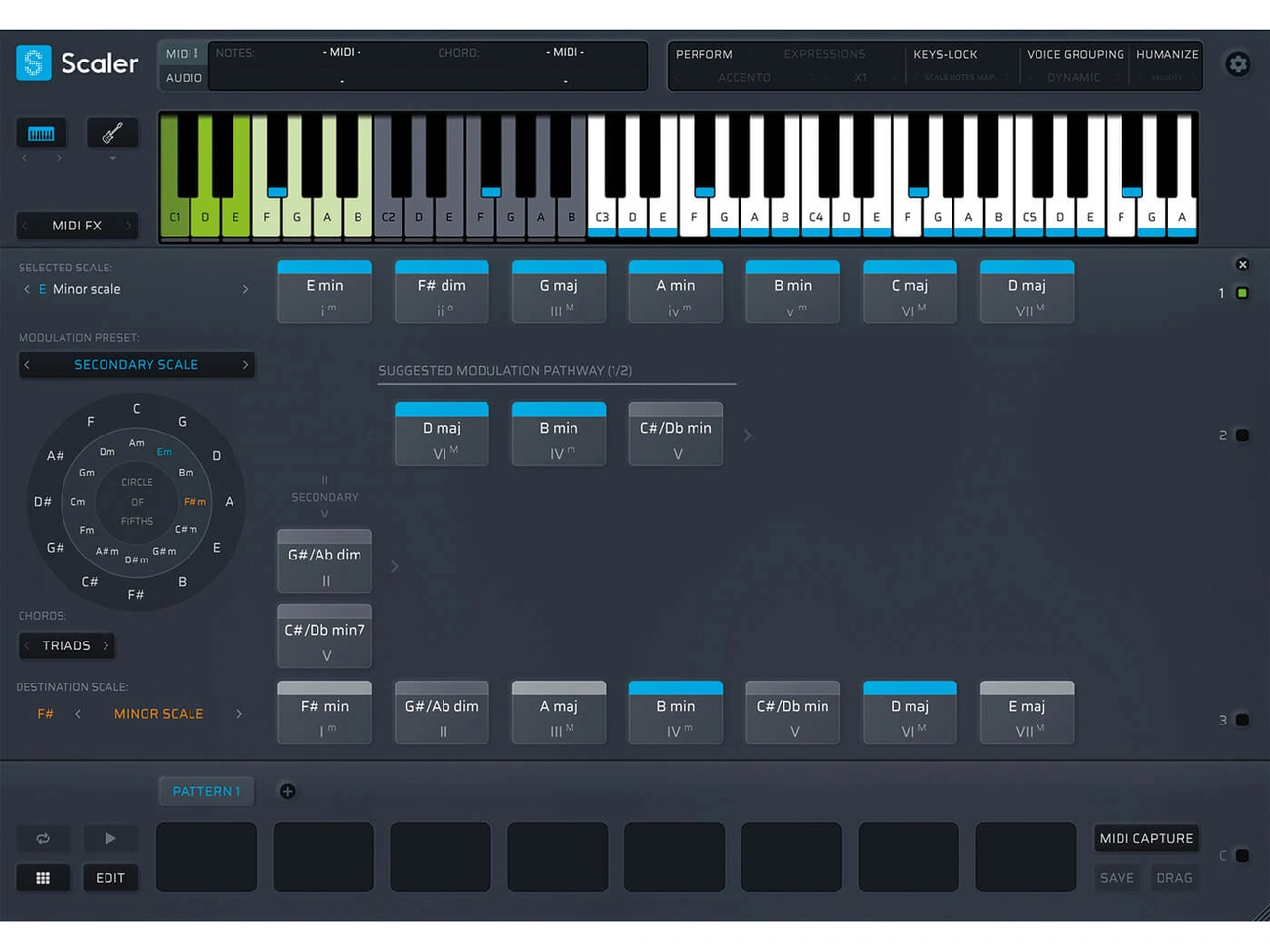
Image Source: MusicTech
“Scaler 2 Plugin is a (VST/AU/AAX) plugin for composers and producers, which simplifies working with scales, chords, and melodies.” — Fabio Ricci, Editor, AudioNewsRoom
Scaler 2 plugin is a complete music theory and chord progression tool that helps composers and producers work with scales, chords, and melodic elements. This versatile plugin is a successor to the original Scaler and features a ground-up redesign to give musicians a rich, creative toolkit.
Plugin Type and Compatibility (VST/AU/AAX)
Scaler 2 plugin comes in three different versions to fit various production needs:
- Standard Scaler 2 – A virtual instrument that detects chords from audio and MIDI inputs while controlling external instruments.
- ScalerControl – Explicitly built for DAWs that support AU MIDI-controlled effect plugins. Logic Pro users who need to control external instruments will find this version particularly useful.
- ScalerAudio – An audio effect that analyzes audio content directly from tracks. This version works great for detecting chord progressions from recorded performances.
The plugin works with many platforms and DAWs. It supports VST, VST3, AU, and AAX formats so you can use it with almost any modern production setup. The software runs well on Windows (8 or higher) and macOS (10.14+), including native support for Apple Silicon. You can use this chord progression plugin with popular DAWs like Ableton Live, Pro Tools, Logic Pro, FL Studio, Cubase, Studio One, Bitwig, and Reaper.
Musicians can activate the plugin on up to three devices, which gives them flexibility with their studio setup and mobile workstations.
Target Audience: Beginners to Advanced Producers
Plugin Boutique Scaler 2 shines because it works well for users at all skill levels. It can be used as a learning tool by beginners who know little about music theory. The plugin’s massive library of scales and chords helps them understand composition basics.
Mid-level producers will love how Scaler 2 improves their workflow and sparks creativity. One reviewer said, “Using Scaler 2 is like having an assistant to capture and expand on my ideas”. The plugin helps when you need fresh chord variations and voicings.
Advanced musicians get deep customization options and efficiency tools. Voice Grouping stops awkward jumps between chords, and the Modulation section helps create sophisticated key changes. These features let experienced users fine-tune their compositions rather than just getting basic theory help.
Musicians use Scaler 2 in many different genres. Electronic producers can make significant progress even without formal training. Film composers use quick chord substitutions and modulation features to create emotional scores.
Scaler 2 Plugin vs Scaler 1: Key Differences
The upgrade from Scaler 1 to version 2 brings significant improvements. The developers started fresh with the software, which led to several new features:
- Expanded Content: Scaler 2 adds over 200 new chord sets, hundreds more scales, and 30 new instruments, giving users more creative options.
- Better Detection: Version 2 can analyze audio samples and drag them into the software.
- MIDI Capture: You can now capture performances in the plugin, unlike the original version, which required MIDI recording in your DAW.
- Keys Lock & Melodic Expressions: These features help spark ideas while keeping notes in your chosen key.
- Voice Grouping: This innovative feature creates smoother progressions by preventing harsh interval jumps between chords.
- Improved Editor: The Chord Builder lets you customize each chord in more detail.
- Better UI: The interface got a complete makeover, making it more user-friendly.
Current Scaler 1 owners can still use both versions, but Scaler 2’s improvements make it much more potent for music production and composition. Most producers will find the upgrade worth it because of the extra features.
It’s worth mentioning that Scaler 2 has been discontinued since Scaler 3’s release, but current license holders can still access it.
Core Features of Scaler 2 Plugin
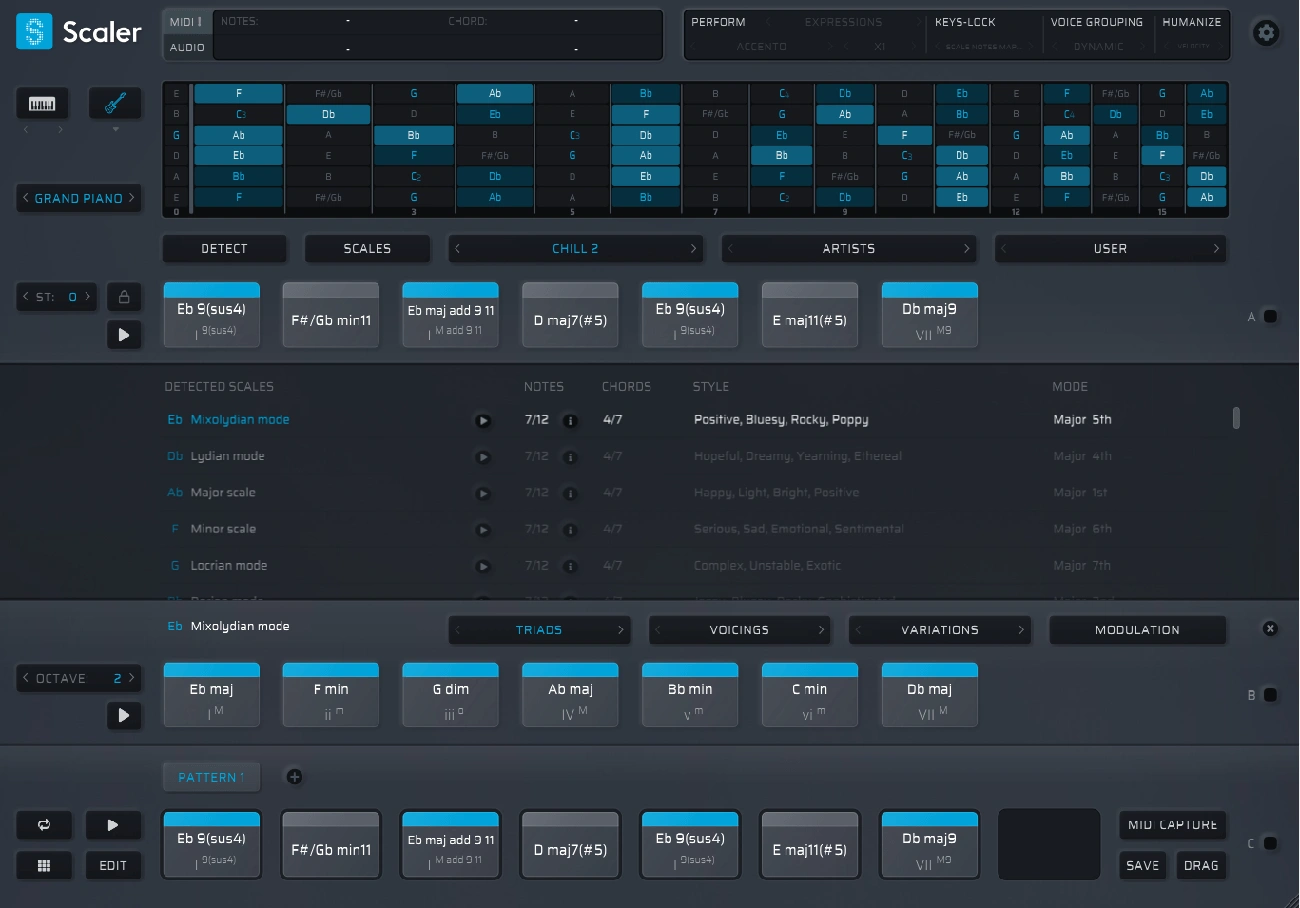
Image Source: Sound & Design
My six months with Scaler 2 showed me that its core features go beyond simple chord suggestions. The plugin’s robust toolkit helped me speed up my composition process, especially when I hit creative blocks.
Chord Detection: MIDI and Audio Input
Scaler 2’s detection abilities are better than its predecessor’s, with MIDI and audio analysis options. The MIDI detection delivers 100% accuracy because it processes note data directly. Audio detection lets me drag audio files onto the interface or use Scaler Audio to analyze live performances. While audio detection isn’t as reliable as MIDI analysis, it works great with single instruments like piano or guitar.
The detection process worked smoothly in DAWs like Ableton Live and Studio One. I route MIDI or audio to the track and press record in the Detect screen to find chords. Dragging files from my computer folders (not from within the DAW) works just as well.
Chord Suggestions and Progression Builder
After detection finds your key and scale, Scaler 2’s suggestion engine shows you many progression possibilities. The plugin gives you several suggestion modes:
- Per Scale – Suggests chords based on your detected scale
- Tonal – Proposes chords that might be outside your scale but complement it tonally
- Pattern Fill/Replace – Automatically completes your progression with compatible chords
The “Minimize Movement” option creates smoother transitions between chords through inversions. The Modulation page offers new creative options through Modal Interchange, Mediators, and Neo-Riemannian techniques. These techniques are great for dramatic film scoring projects.
Performance Panel: Phrases, Rhythms, and Arpeggios
The Performance panel brings static chords to life. Scaler 2 has over 200 performances, phrases, and rhythms created by professional musicians. These patterns range from simple arpeggios to complex melodic expressions in different time signatures.
Expression controls let you customize these performances with humanization options for velocity and timing. Voice grouping adds more voicing options. I often use the “dynamic” setting that finds inversions while keeping fingerings close to the scale tonic.
The arpeggio features sync perfectly with the tempo of my DAW for my electronic productions. Bass and melody generation modes are great for supporting parts that adapt to my chord progression.
Key Lock and Humanize Options
Key Lock helps me create melodies without hitting wrong notes. This feature comes with five distinct modes:
- Scale Notes Mapped – Maps non-scale notes to the nearest scale note
- Scale Notes Only – Silences non-scale notes
- Scale White Keys – Maps white keys to scale notes
- Chord Notes – Only plays notes from the selected chord
- Chord Extensions – Plays extended chord notes
Humanization features add subtle changes to timing and velocity that create natural-sounding performances. I wish I had more control over the humanization amount, but the current setup still adds realism to mechanical MIDI sequences.
Internal Instruments and Sound Presets
Scaler 2 has 49 preset sounds in categories like pianos, synths, guitars, and orchestral instruments. These internal sounds let me sketch ideas quickly without resorting to external instruments.
The best additions are a choir, hybrid staccato strings with synth pad, acoustic guitar, Sign (a mellow synth), and Detroit (an old-school rave synth). The strummed acoustic guitar performances sound realistic when I enable expressions and set them to strumming mode.
The plugin works best with external sound sources, but Scaler 2’s internal sounds often end up in my final productions. You can route MIDI to any VST/AU instrument in your DAW, making it versatile as both an ideation and performance tool.
Real-World Studio Use: 6-Month Test Insights
“It’s relatively easy to use, a constant inspiration source, and it works great with all the other instruments/libraries I have.” — Fabio Ricci, Editor, AudioNewsRoom
Over the past six months, I’ve tested the Scaler 2 plugin in many production scenarios. My hands-on experience taught me much more than what you’d learn from reading about features.
Getting Started and Learning the Ropes
Setting up Scaler 2 is simple, but there’s much to learn. New users should start with voice grouping. This feature keeps your chords roughly in the same position, whatever notes you play. The result is smoother transitions between progressions.
The “dynamic voicing” profile at the top of the settings menu gives you the smoothest transitions—that’s what I learned early on. Once you’re comfortable, you should check out the Pad View. This lets you try different song parts without leaving the plugin.
The plugin might look complicated at first. Even after months, I kept finding new features. Here’s a quick way to start:
- Select a scale in the upper section
- Explore chord suggestions in the middle section
- Create progressions in the lower section
- Enable voice grouping for smoother transitions
Scaler 2 Plugin Performance in Different DAWs
Each DAW handles Scaler 2 differently. Here’s what I learned during testing:
- Ableton Live: You can’t use Multi-Voice Output right away, but the macOS IAC Driver helps route MIDI across channels
- Logic Pro: You’ll need ScalerControl for everything to work right. DAW Sync should be on
- Studio One: Works great out of the box—just set Scaler as your instrument track’s input, arm it, and hit record
- Reaper: Handles Multi-Voice Output well with both multi-timbral and mono-timbral plugins
- FL Studio: Works fine, but needs specific port settings in the VST Wrapper Settings
VST2 or VST3 versions work better across DAWs than AU, which also can’t handle multi-channel MIDI output.
Making MIDI Capture and DAW Sync Work for You
MIDI Capture makes my workflow much faster. Here’s how to grab Scaler’s output:
- Create your chord progression in Scaler 2
- Hit the MIDI Capture button to record what you play
- Drag the captured MIDI to your DAW’s timeline
You need DAW Sync, or multiple Scaler instances won’t play together. To do so, click the gear icon, head to Playback settings, and turn DAW Sync “On.” This keeps Scaler locked to your DAW’s timeline.
Recording multi-voice output has some quirks. Reaper users must set Record Output to “MIDI.” Logic Pro users need an external MIDI track with ScalerControl routed through the IAC driver.
Real-World Uses: From Songs to Scores
Scaler 2 works best as a starting point for creativity. My songwriting process looks like this:
- Try out chord progressions in Scaler 2
- Please pick one I like and use its key
- Use force-key to shape other progressions
- Send these progressions to sequencers/arpeggiators
Film composers will love the modulation page. It helps create emotional shifts using chromatic median and modal interchange techniques.
You can also build tracks from melodies instead of chords. Chord Binding lets you play single notes – like humming with your fingers – while Scaler 2 creates matching chords in real-time.
Electronic music producers can send Scaler to several instruments at once. This creates layered arrangements in which chord progressions stay in sync, but each part has its own feel.
Scaler 2 Plugin Review: Modulation and Arrangement Tools
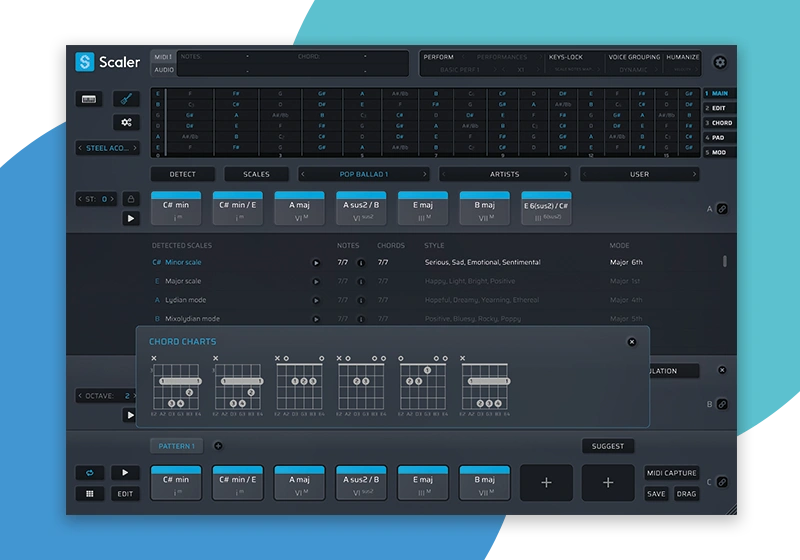
Image Source: Plugin Boutique
The modulation tools in the Scaler 2 plugin have reshaped how I approach harmonic development, beyond simple chord progression building. These advanced features let you make sophisticated key changes and arrangement possibilities requiring extensive music theory knowledge to be manually created.
Modulation Panel and Circle of Fifths
Scaler 2’s most powerful feature is its modulation panel, which offers several approaches to modulating between keys. The Progression modulation mode has benefited my songwriting over the past six months. It creates smooth transitions between keys using the Circle of Fifths graphic. Scaler 2 automatically suggests a series of chords that create a natural pathway between your original and target keys when you select a destination.
The Mediants modulation option has proven invaluable for film scoring projects. This feature lets you explore creative routes between chords outside the selected key. It gets more and thus encourages more interesting chord changes that would be impossible through random experimentation alone, even with advanced music theory knowledge.
The Circle of Fifths visualization is a navigation tool and a chord suggestion system. Scaler 2 immediately displays numerous variations of that chord when you select a chord from the inner circle (like Cm at the 9 o’clock position). This makes finding alternatives with similar tonality but different emotional qualities easy.
Chord Substitutions and Voice Grouping
Voice grouping changes the fundamental sound of chord progressions by controlling note ranges and inversions. The “dynamic” option automatically spots inversions of each chord to keep fingerings close to the scale tonic. Your transitions between chords become smoother without jarring jumps.
Voice grouping comes in several flavors:
- Dynamic: Creates automatic inversions for smooth transitions
- Dynamic + 1 Oct: Keeps all chords within the same octave
- Custom groupings: Force chord playback into specific octave ranges
My progressions flow naturally with minimal finger movement, making them more playable and musical. This greatly improved from awkward jumps in chord transitions before voice grouping.
Pad View and Pattern Switching
Scaler 2’s Pad View improves by letting you see multiple patterns simultaneously. In this expanded view, you can develop complete song structures with intro, verse, bridge, chorus, and outro sections visible simultaneously.
Pattern switching through key switches has become essential to my workflow. You can instantly jump between sections during live performance or recording by mapping different patterns to key switches (using A-G keys by default). This helps especially when building arrangements with contrasting chord progressions.
Scaler 2’s biggest problem is its lack of Song Position Pointer functionality—it doesn’t automatically follow your DAW’s timeline position. Notwithstanding that, I’ve worked around this by using pattern key switches at section changes to stay in sync with my arrangements.
Scaler 2 Plugin Pricing and Upgrade Options
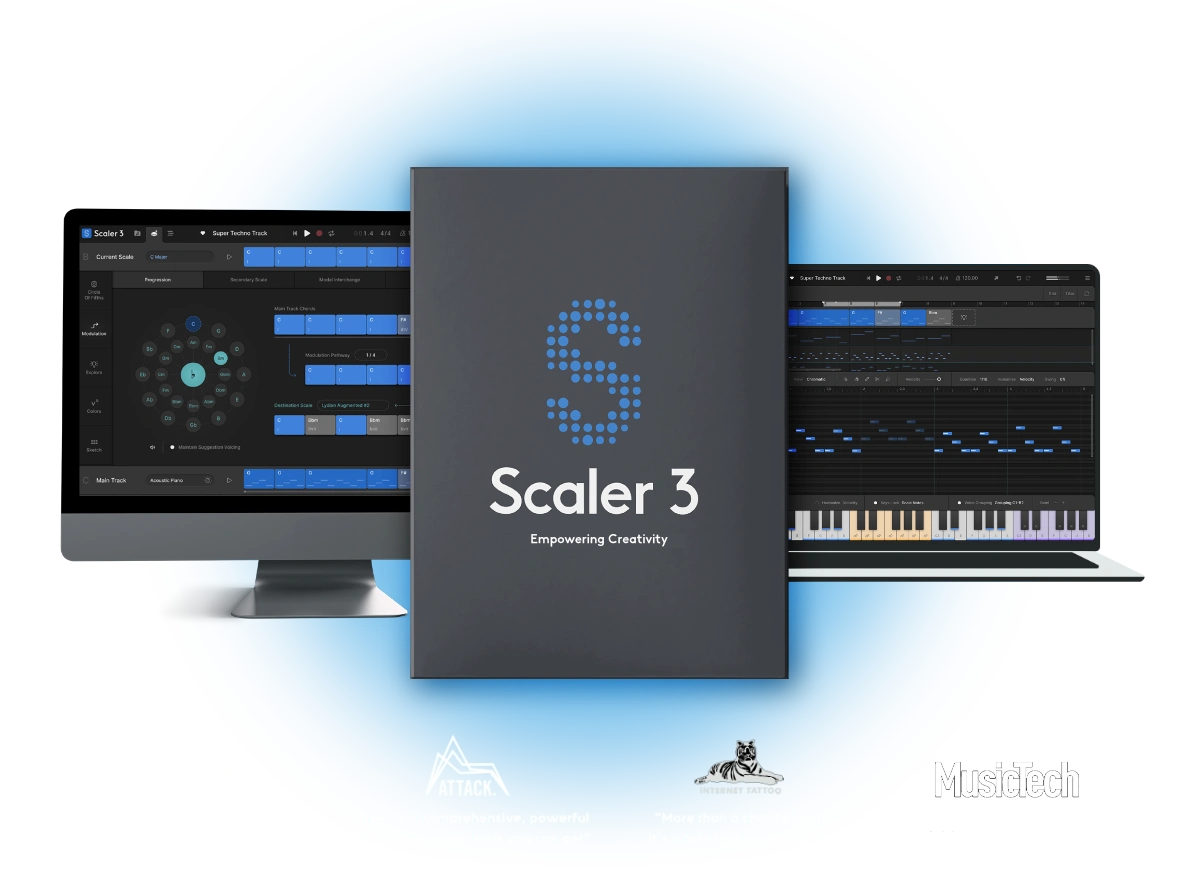
Image Source: Scaler 2
My six-month evaluation of the Scaler 2 plugin revealed several pricing options. The cost varied based on timing and purchase location.
Scaler 2 Plugin Price for New Users
The standard retail price for Scaler 2 on Windows and Mac systems (supporting VST/VST3, AU, and AAX formats) was $59.00. Sales were frequent, with prices dropping to $29.00 during a November 2024 promotion on Plugin Boutique. The plugin’s final sale price reached $49.00 in January 2025 before discontinuation.
iPad users had a different pricing structure. The App Store offered Scaler 2 as a free download with most features unlocked. Users could unlock all remaining features through a $18.99 in-app purchase.
The release of Scaler 3 led to the discontinuation of Scaler 2, making it unavailable for new users. The transition included a 25% introductory discount to help users adopt the newer version.
Upgrade Cost from Scaler 1
Scaler 1 owners received substantial discounts on Scaler 2 upgrades. The standard upgrade price was $29.00, but it was reduced by 48% to $15.00/$18.70 during promotional periods.
Users could get the discounted upgrade by logging into their Plugin Boutique account. The system detected Scaler 1 licenses automatically. Plugin Boutique sweetened the deal before Scaler 2’s release by offering Scaler 1 a free upgrade to version 2.
Is There a Free Version or Trial?
A 30-day trial version helped users test Scaler 2 before buying. The trial process was straightforward:
- Create a Plugin Boutique account
- Go to the Scaler 2 product page
- Click the “TRIAL VERSION” button
- Download and install the trial from your account
- Select “Continue evaluation” at first launch
The trial period couldn’t be extended or reset after expiration. This month-long evaluation gave users enough time to explore the plugin’s features before purchase.
Where to Download the Scaler 2 Plugin
Current license holders can download the plugin based on their purchase location. Scaler Music customers can access it through their website account. Plugin Boutique buyers need to log in to their respective platform accounts.
After discontinuation, the plugin remains available only to existing license holders. It works on computer systems compatible with 2025 standards, though updates have ceased.
Scaler 2 Plugin Review: Pros and Cons After 6 Months
Six months of daily studio sessions with this chord progression tool have revealed Scaler 2 plugin’s ups and downs. This review digs deeper than a simple feature list to examine its performance in real-life production situations.
Top Advantages: Flexibility, Inspiration, and Value
Scaler 2’s greatest strength is its creative inspiration capabilities. Compared to similar music theory tools, the plugin offers exceptional value at $59 (sometimes dropping to $29 during sales). The chord detection feature identifies progressions correctly from both MIDI and audio inputs, which makes it a great way to get help transcribing existing music.
Scaler 2 changed my songwriting approach through its suggested modulations and alternative chord voicings. The Keys-Lock feature became my secret weapon. It helps generate melodies that stay in key, perfect when writer’s block hits.
One forum user said, “Scaler will expedite your exploration of chords and scales”. This observation holds. Even months later, I kept finding new creative possibilities through its extensive preset library.
Limitations: UI Complexity and Learning Curve
The detailed toolset has a steep learning curve that balances out these benefits. The multitude of options often overwhelms new users. One reviewer noted, “We had to watch quite a few YouTube tutorial videos before we felt comfortable with it”.
The powerful interface layout requires dedicated time to direct effectively. Simple functions like undo/redo aren’t always where you’d expect them—I often wish these buttons were available on every page instead of just the Edit page.
New users should start with these simple steps:
- Select a scale in the upper section
- Browse chord suggestions
- Build progressions in the sequencer
- Enable voice grouping for smoother transitions
Bugs and Stability Observations
The stability varied a lot across different DAWs. Scaler 2 worked reliably most of the time, but some notable issues came up:
Pro Tools users reported consistent crashes with version 2.9.0, especially on M1 Macs running macOS 13.6.7. These showed up as glitches when recording or stopping playback, often creating AAE-6101 errors.
Ableton Live users sometimes experienced severe lag and freezing when launching the plugin. They worked around this by turning off OpenGL rendering through the ScalerSettings application.
Studio One also had freezing issues when exporting audio from projects with Scaler 2. Users typically solved this by removing Scaler from tracks before bouncing.
These compatibility issues caused frustration but didn’t overshadow the plugin’s usefulness during my testing period.
Conclusion
Final Thoughts: Is Scaler 2 Plugin Worth It in 2025?
My six months of studio testing prove Scaler 2 belongs in my production toolkit. Even though Scaler 3 has replaced it, the plugin still delivers excellent value to license holders.
This plugin bridges the gap between music theory knowledge and real-world use. It detects chords from audio and MIDI inputs with high accuracy. The suggestion engine helps me find creative alternatives when I’m stuck. The modulation tools have revolutionized my approach to key changes. What used to be a complex theory process now feels natural and inspiring.
All the same, you should think about a few things before searching for a license. The plugin’s learning curve is steeper than its competitors. You’ll need time to become skilled at its many features. DAW compatibility varies too. Logic Pro users need the specific ScalerControl version. Pro Tools users might face stability issues, especially on newer Mac systems.
Plugin Boutique Scaler Torrent is a learning tool and creative assistant for music theory beginners. Experienced producers can work faster and find new inspiration. The standard price—$59, sometimes on sale for $29—offers great value compared to similar tools.
Current license holders should keep using Scaler 2 without worry. The plugin will work on compatible systems forever, though future OS updates might cause issues. New buyers should look at Scaler 3 instead, which builds on these solid foundations with new features.
This plugin has changed how I work with chord progressions and harmony. I spend less time on simple theory work and more time creating, which is exactly what technology should do for modern producers. From electronic music to film scores and traditional songwriting, Scaler 2’s depth and usefulness still surprise me long after my original excitement fades.
FAQs
Q1. Is Scaler 2 suitable for beginners with limited music theory knowledge?
Yes, Scaler 2 is designed to be accessible for beginners while also offering advanced features. It is an educational tool that makes chord theory more approachable, providing an extensive library of scales and chords to help users learn the fundamentals of composition.
Q2. Can Scaler 2 generate melodies in addition to chord progressions?
While Scaler 2 primarily focuses on chord progressions, it does offer melody generation capabilities. Users can select the “melody” option under the Performance settings to create melodic lines complementing the chosen chord progression.
Q3. How does Scaler 2 compare to other chord progression tools?
Scaler 2 stands out for its comprehensive features, including chord detection, progression suggestions, and modulation tools. It offers a user-friendly interface and smooth workflow for creating and editing chord progressions, making it a popular choice among producers and composers.
Q4. What are the key differences between Scaler 2 and Scaler 3?
Scaler 3 builds upon Scaler 2’s foundation with several enhancements, including VST/AU instrument plugin hosting, multi-track operation, a redesigned interface, and expanded arrangement capabilities. It also introduces new features like the “Explore” page for discovering related chords and variations.
Q5. Is Scaler 2 worth purchasing for someone new to music production?
Scaler 2 can be a valuable tool for those new to music production. It helps users understand chord relationships, explore different progressions, and experiment with harmonies. While it has a learning curve, many users find it speeds up their workflow and enhances creativity once they become familiar with its features.